
Forks in Southeast Asia: Evidence of Cultural Middle-grounding in Colonial ContextsA presentation by Jakob Daraban
Middle Grounding
The term, "Middle ground", is not a physical place so much as it is a metaphor for the processes that link intricate connections between social, cultural, political, economic, juridical, and environmental aspects of everyday life (Deloria 2006: 20).
Hybridization of CultureWho has agency?
Whenever two or more cultures interact with one another, hybridization of those cultures may occur.
This acknowledges marginalized groups' actions within colonial systems as having agency instead of mere reactions to colonial administrations (Deloria 2006: 16).
This acknowledges marginalized groups' actions within colonial systems as having agency instead of mere reactions to colonial administrations (Deloria 2006: 16).
The Fork
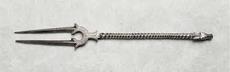
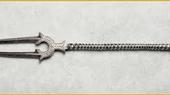
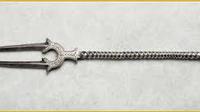
Lets begin with a quick history of the fork; "It has been argued that the invention of the (two-pronged) fork dates back to the 11th century, when, according to Petrus Damianus, it was introduced to Venice by the Byzan- tine princess Theod". By the 11th Century, the Byzantine two prong fork had appeared in Venice, and slowly spread so that by the 16th Century the fork had made its' way into Northwestern Europe (Vionis et al. 2010: 453).
Social Status and the Fork
Before the widespread use of the Fork, the utensil was used by elites and made from expensive materials that often required importation of precious metals. Once the fork became more culturally integrated, the class struggle surrounding the object shifted to serving/cooking utensils vs. only for consumption utensils (Vionis et al. 2010: 433)
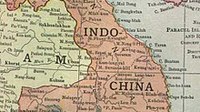
Introduction of the Fork to French Indochina
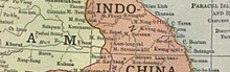
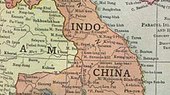
Until the invasion of the French into the region, the fork was not commonly used; "Cambodians did not use the fork in the past. Forks were used after the invasion of the French." and, "Forks were used amongst the elite Cambodians who live in the city" (Leang interview: 2019)
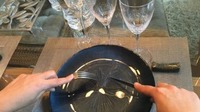
French Fork Etiquette
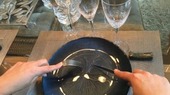
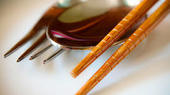
To better understand the cultural history of the fork in the Indochina region, lets look at the differences in contemporary fork usage in France and Cambodia. According to an on line travel article, French table etiquette (as it refers to forks) is something like: If no other utensil is being used, the fork may be in the right hand; If using a fork and knife, the fork must stay in the left hand and is used to support the cutting action of the knife in the right hand; Resting position of your fork should be tines down; Even when bringing the food to your mouth, the fork must stay in the left hand to remain proper - unlike the hand switching common in American fork usage.
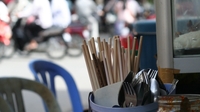
Cambodian Fork Etiquette
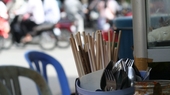
In a similar manner, a Cambodian travel article outlines the cultural norms behind utensil use in a Cambodian context. According to the article, the fork is always kept in the left hand to support the spoon in the right hand; the spoon in the right hand is the main utensil used to bring food to the mouth; and typically, forks are available in utensil stations around food stalls in a marketplace setting.
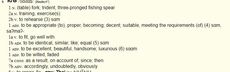
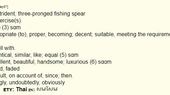
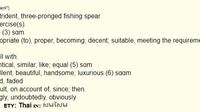
Called សម (saam) in Khmer, but សម also means many other words, such as សម sɑɑm 1 n (table) fork; trident, three-pronged fishing spear 2a n training, exercise(s). 2b v to rehearse (3) sɑm 1 adj to be appropriate (to), proper, becoming; decent; suitable, meeting the requirements (of) (4) sɑm, saʔmaʔ- 1a v to fit, go well with. 1b adj to be identical, similar, like; equal (5) sɑm 1 adj to be excellent, beautiful, handsome; luxurious (6) sɑɑm 1 adj to be wilted, faded 7a conj as a result, on account of, since; then. 7b adv accordingly, undoubtedly, obviously 8 v to repair, fix (SEAlang.net/khmer)
Called សម (saam) in Khmer, but សម also means many other words, such as សម sɑɑm 1 n (table) fork; trident, three-pronged fishing spear 2a n training, exercise(s). 2b v to rehearse (3) sɑm 1 adj to be appropriate (to), proper, becoming; decent; suitable, meeting the requirements (of) (4) sɑm, saʔmaʔ- 1a v to fit, go well with. 1b adj to be identical, similar, like; equal (5) sɑm 1 adj to be excellent, beautiful, handsome; luxurious (6) sɑɑm 1 adj to be wilted, faded 7a conj as a result, on account of, since; then. 7b adv accordingly, undoubtedly, obviously 8 v to repair, fix (SEAlang.net/khmer)
Signs of cultural hybridization?
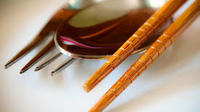
Cultural hybridization may present itself in ways that might not seem incredibly obvious; the best way to find potential examples of hybridization would be to observe noticeable differences and similarities between object use. French and Cambodian fork use is similar in that both emphasize the use of the fork in the left hand, and both view the role of the left-hand utensil to support the primary actions of the right-hand utensil. However, the French context has incredibly ridged rules in place, which dictate many small details, and the French context also utilizes knives and an alternating purpose and hand use of the fork dependant on the knife's usage.
Interview - Kheang Leang
I interviewed three Cambodian people who now live in America, and asked about the differences in fork usage between America and Cambodia in their personal experiences.
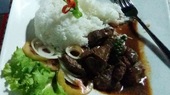
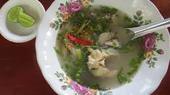
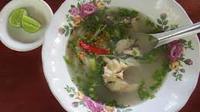
My first interview was with Kheang Leang, my Khmer language professor. From my interview with him I learned that he believes the biggest usage for a fork is to keep food on the plate, however the usefulness of that is mitigated by the fact that many dishes in Cambodia are served in bowls, which naturally hold food in. The interview reinforced the travel article with the usage of the fork in the left hand and spoon in the right hand, however the interview revealed that flipping that wouldn't be a "big deal". Some resterants will not give you a fork unless you ask for one, and in a majority of instances food is eaten with chop sticks and a spoon - for example noodles and soups. Although there is no penalty for using the fork, Kheang sees the spoon as the main eating utensil.
My first interview was with Kheang Leang, my Khmer language professor. From my interview with him I learned that he believes the biggest usage for a fork is to keep food on the plate, however the usefulness of that is mitigated by the fact that many dishes in Cambodia are served in bowls, which naturally hold food in. The interview reinforced the travel article with the usage of the fork in the left hand and spoon in the right hand, however the interview revealed that flipping that wouldn't be a "big deal". Some resterants will not give you a fork unless you ask for one, and in a majority of instances food is eaten with chop sticks and a spoon - for example noodles and soups. Although there is no penalty for using the fork, Kheang sees the spoon as the main eating utensil.
Interview - Pheanusa Ty
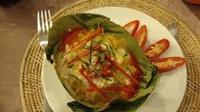
The third person I interviewed was Pheanusa Ty, or Brandon (his chosen American name), a Cambodian undergraduate student at NIU. From his experience, he sees American people using utensils separately while eating, which contrasts from his experiences in Cambodia, where forks are usually used in combination with spoons for scooping food. Pheanusa prefers to use chop sticks since he believes them to be the most versatile utensil, being able to pick up many different types of foods in a convenient and quick manner. The last time he was in a Cambodian market for a meal, he used a spoon and fork, despite his chop stick preference. Spoon and fork are the utensils typically given to him whenever there is not a utensil holder at his table brandishing spoons, forks, and chop sticks.
Interview - Iyounan An
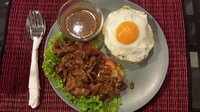
The second person I interviewed was Iyounan An, a Cambodian graduate student at NIU. Iyounan reinforced the notion that the fork is used alongside the spoon as a supplementary utensil; however, he notes that the fork is not always used in tandem with a spoon, typically in instances where the meal itself does not require a fork to eat, but would rather use the fork to grab and scoop to the plate larger pieces of meat. Iyounan uses the spoon utensil the most, since he believes it goes well with most all foods and makes eating easier, especially since a majority of Cambodian foods require a spoon like, "rice, soup, stir fry, and so on".
Works Cited
How To Place Your Hands And Silverware At The French Table, online article by Camille Chevalier-Karfis.
Cambodian table manners, a travelfish.org article
Interviews with Kheang Leang, Iyounan An, and Pheanusa Ty
Deloria, Philip J. "What Is the Middle Ground, Anyway?" William and Mary Quarterly63, no. 1 (2006): 15. doi:10.2307/3491723.
Vionis, Athanasios K., Jeroen Poblome, Bea De Cupere, and Marc Waelkens. "A Middle–Late Byzantine Pottery Assemblage from Sagalassos: Typo-Chronology and Sociocultural Interpretation." Hesperia79, no. 3 (2010): 423-64. doi:10.2972/hesp.79.3.423.
SEAlang.net/Khmer - Khmer dictionary
Cambodian table manners, a travelfish.org article
Interviews with Kheang Leang, Iyounan An, and Pheanusa Ty
Deloria, Philip J. "What Is the Middle Ground, Anyway?" William and Mary Quarterly63, no. 1 (2006): 15. doi:10.2307/3491723.
Vionis, Athanasios K., Jeroen Poblome, Bea De Cupere, and Marc Waelkens. "A Middle–Late Byzantine Pottery Assemblage from Sagalassos: Typo-Chronology and Sociocultural Interpretation." Hesperia79, no. 3 (2010): 423-64. doi:10.2972/hesp.79.3.423.
SEAlang.net/Khmer - Khmer dictionary
Scrollen, um weiterzulesen
Wischen, um weiterzulesen
Wischen, um Text einzublenden














 Forks in Southeast Asia: Evidence of Cultural Middle-grounding in Colonial Contexts
 Middle Grounding
 Hybridization of Culture
 The Fork
 Social Status and the Fork
 Introduction of the Fork to French Indochina
 French Fork Etiquette
 Cambodian Fork Etiquette
 Signs of cultural hybridization?
 Interview - Kheang Leang
 Interview - Pheanusa Ty
 Interview - Iyounan An
 Works Cited